
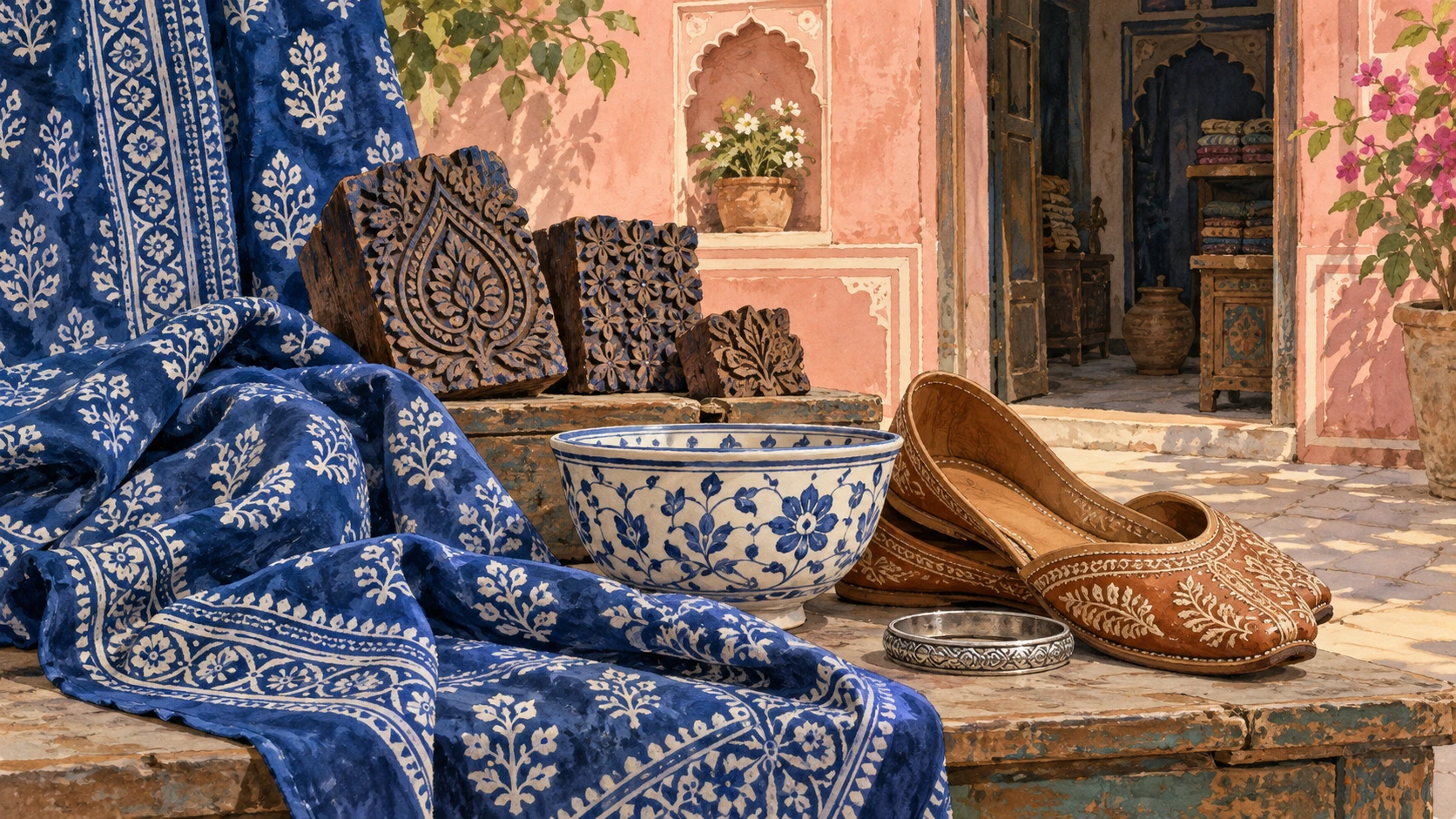
Pick a craft before a shopping circuit
Jaipur's craft traditions offer more than one kind of keepsake. A printed textile, a piece of blue pottery, lac bangles and jootis ask different questions of the buyer. Begin with the object and who will use it instead of trying to complete every bazaar in an afternoon.
Bapu Bazaar and the old-city shopping streets can provide a starting point, but a market name is not a quality guarantee. Look before buying and compare like with like. A discount is useful only after you understand the material, dimensions and finish it applies to.
Sanganeri and Bagru prints: ask about process
Sanganeri and Bagru are names associated with Rajasthan's printing traditions. In a shop, ask whether the specific cloth is hand-block printed or produced by another method, and what fibre it uses. A pattern that resembles a traditional design does not establish the printing process.
Choose the form you need: dress material, a garment, a scarf or a home textile. Check the dimensions and care instructions. If you need stitching, ask about the additional cost and completion time before buying material for a garment that must be ready before your departure.
Blue pottery: decoration and function differ
Jaipur blue pottery uses a quartz-based body rather than the ordinary clay body a buyer might expect from the word pottery. Its painted and glazed surfaces make plates, tiles, boxes and other objects appealing, but an attractive surface does not tell you the intended use.
Ask whether a plate is decorative or suitable for food, and whether the maker provides any handling or washing instructions. Inspect the edges and glaze for damage. Choose a size you can pack safely; a large fragile object can turn a simple shopping afternoon into a shipping problem.
Lac bangles and jootis need a fit
For lac bangles, fit and finish matter as much as colour. Check the inside for rough edges and the decoration for loose pieces. Ask how the material should be handled and stored. Do not force a rigid bangle onto your hand to prove that the size is right.
For jootis, try both shoes where permitted and walk a little. Examine seams, lining and the sole, and ask what materials are used. Embroidery does not answer whether a shoe will be comfortable for the wearer. For a gift, measurements are more useful than a guess based on a familiar size label.
Keep precious-metal buying separate
Jewellery can be another Jaipur outing, but a major precious-metal or gemstone purchase needs its own time and documentation. Do not treat it as a quick addition to a craft browse. Appearance, weight and an enthusiastic description are not proof of purity, stone identity or value.
For every purchase, agree the item and total together, check the parcel and retain the bill. Ask about returns, additional work and packing before payment. The useful Jaipur souvenir is a piece whose making and care you can explain, not something bought to complete a list.
Choose a printing study or a city-shop visit
Anokhi’s flagship Jaipur shop is listed at KK Square on Prithviraj Road in C-Scheme. The Anokhi Museum of Hand Printing is separately located near Keri Gate in Amber. A shop visit and a museum visit can each be worthwhile, but they answer different questions. Choose the one you intend instead of using a brand name as an address.
The museum presents printed textiles with tools and related objects, offering a way to look at the making process before shopping. Current demonstrations or workshops need confirmation. A display of printing traditions does not automatically authenticate every cloth sold across Jaipur or promise a hands-on session on any arrival day.
Pick a bazaar or a showroom, not a whole shopping marathon
Rajasthan Tourism lists Johari Bazaar, Bapu Bazaar, Nehru Bazaar, MI Road and the Rajasthali government showroom on MI Road among Jaipur's shopping places. Use those names as starting points for a visit, not as endorsements of every seller or every object. A showroom browse and an old-city street browse have different rhythms; choose the setting that suits your time and energy.
Ask about the specific shop's opening before setting out. Do not assume an entire bazaar follows one timetable or that a Sunday notice settles every counter's availability. Give yourself room to compare a few pieces without turning a shopping day into a checklist of market names.
Textile first: a finished garment or cloth to be made up?
A scarf or home textile is a different purchase from a saree, fitted garment or length of cloth that still needs stitching. Decide the use, then ask about fibre, dimensions, lining and care. For a saree, check whether the blouse piece is included; for a garment, inspect seams and try the fit where possible. Ask about colour care rather than assuming every vivid print washes the same way.
Anokhi Museum of Hand Printing in Amber offers a separate way to understand textiles through printed cloth, tools and related objects. Its exhibitions can make a shopping visit more informed, but a museum stop does not prove that a particular shop's fabric is hand printed. Ask the seller about the actual piece you are buying and confirm any alteration cost and completion time.
Jewellery history is a different visit from jewellery buying
Amrapali Museum in C-Scheme describes a collection of jewellery and decorative arts. Its listed location is Ground Floor, K-14/B, Ashok Marg, Panch Batti. That makes it another possible craft-study visit for someone interested in forms and workmanship. Check current admission and visiting arrangements directly rather than treating a museum as a free jewellery counter.
If you then shop, separate a modest decorative accessory from a high-value precious-metal or gemstone purchase. A style name, an attractive surface or a claim that a design is traditional does not establish metal purity, the identity of a stone or investment value. Ask for clear material descriptions and choose a seller willing to document them.
For a hallmarked purchase, the bill is part of the item
BIS's consumer guidance says buyers of hallmarked precious-metal articles should obtain an authentic invoice and lists details such as the article description, precious-metal net weight, purity and hallmarking charges. Read the bill against the piece rather than accepting a generic receipt that says only jewellery. Ask the seller to explain the applicable hallmark and the current verification method.
A metal hallmark does not answer every question about gemstone identity, treatments or value. Keep those questions separate and seek suitable independent verification before a major purchase. Confirm making charges, taxes, alterations and return terms before payment. Nothing in a bazaar's reputation removes the need to understand the particular sale.
Build a souvenir shortlist around life after Jaipur
Choose one piece that has a use at home: cloth you know how to care for, a jutti that fits, a bangle in the right size, or a small pottery object with an understood function. These choices need different checks, so compare within the same category instead of judging everything by how easily it fits a gift list.
Inspect the item that will actually be packed and ask for protection suited to its surface and fragility. Keep the bill and any agreed delivery terms. For expensive shipping or an object sold as antique, pause for a separate check of provenance and destination rules before committing. A worthwhile keepsake does not need a claim of rarity, a hurried bargain or a promised investment return.
Find out more about ZikPe
Explore ZikPe on its official website. Check the current product information and terms there before choosing a payment service for your trip.
Explore the ZikPe app ↗